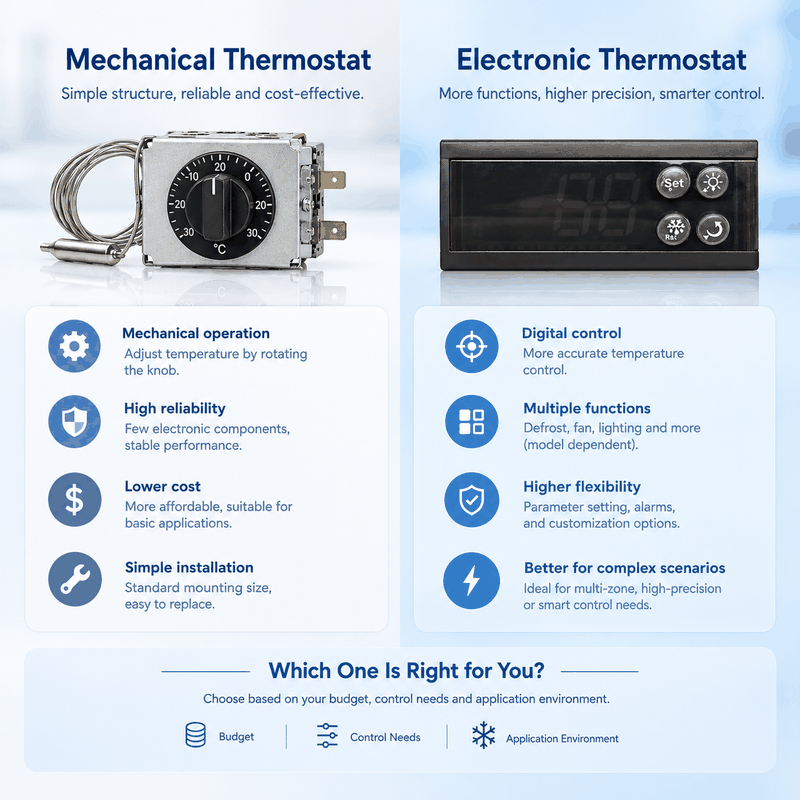
If you are still spec'ing mechanical thermostats on new refrigeration equipment, you are paying a similar price for a fraction of the control. Here's an honest comparison, and where each still makes sense.
The Quick Comparison
| Mechanical Thermostat | Digital Controller | |
|---|---|---|
| Temperature accuracy | ±2–3°C | ±0.5–1°C |
| Hysteresis setting | Fixed by capillary | Adjustable 0.5–15°C |
| Defrost control | Manual or timer only | Automatic, programmable intervals |
| Temperature display | None | Real-time LED display |
| Alarms / diagnostics | None | Sensor fault & high-temp alarms |
| Energy efficiency | Wider swings, more run time | Tighter control, less run time |
| OEM customization | Limited | Firmware, parameters, faceplate |
| Unit cost | Slightly lower | Comparable at volume |
Why OEMs Are Switching
1. Tighter Temperature Control
A mechanical capillary thermostat swings several degrees before the compressor reacts. A digital controller reads the probe continuously and keeps the cabinet inside a much narrower band — which matters for food quality and for passing energy tests.
2. Real Defrost Control
Mechanical units rely on manual or basic timer defrost. Digital controllers offer programmable intervals, defrost termination by temperature, and drip time — so evaporator coils stay frost-free without wasting energy.
3. Adjustable Hysteresis
With a mechanical unit, hysteresis is baked into the capillary design. A digital controller lets the OEM set it per application — wide for frozen meat, narrow for ice cream. You get one hardware platform for many cabinet types.
4. Diagnostics on the Panel
When a sensor fails or a cabinet overheats, a digital controller tells the technician what happened. That shortens service time and lowers your warranty cost.
OEM tip: at volume, a digital controller costs close to a mechanical thermostat — but the cabinet you ship performs better, fails less, and is easier to service. That difference shows up in fewer warranty claims and repeat orders.
When Mechanical Still Makes Sense
Honestly, very few new designs. Mechanical thermostats still survive in ultra-low-cost, single-function products where a display and accuracy are not expected. For anything sold as commercial refrigeration, buyers now expect a digital controller.